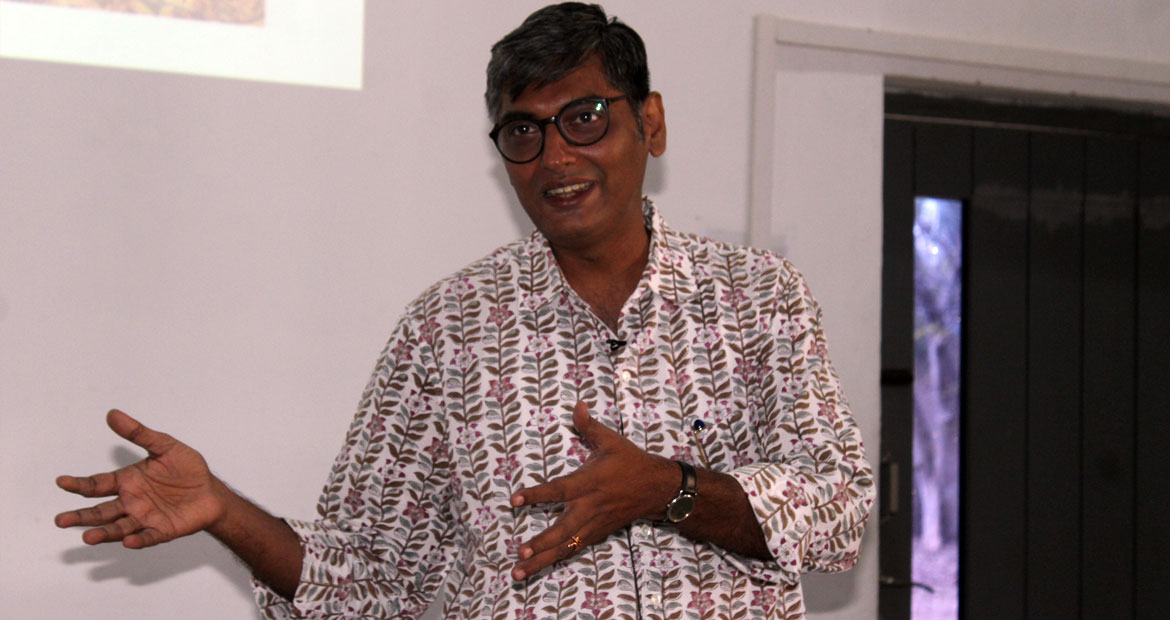
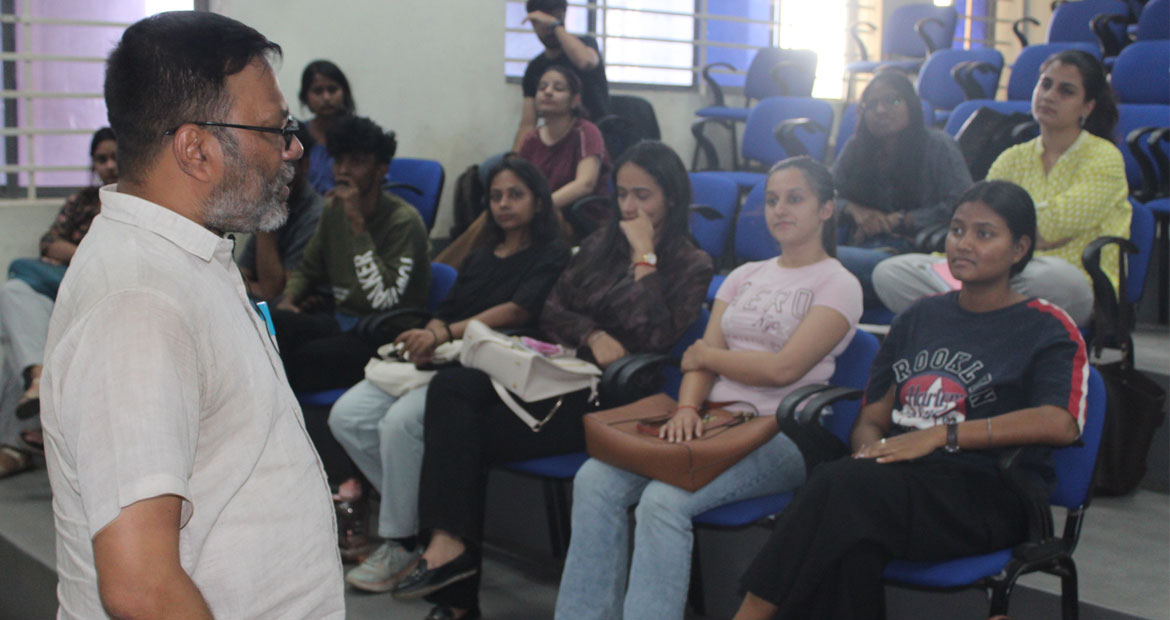
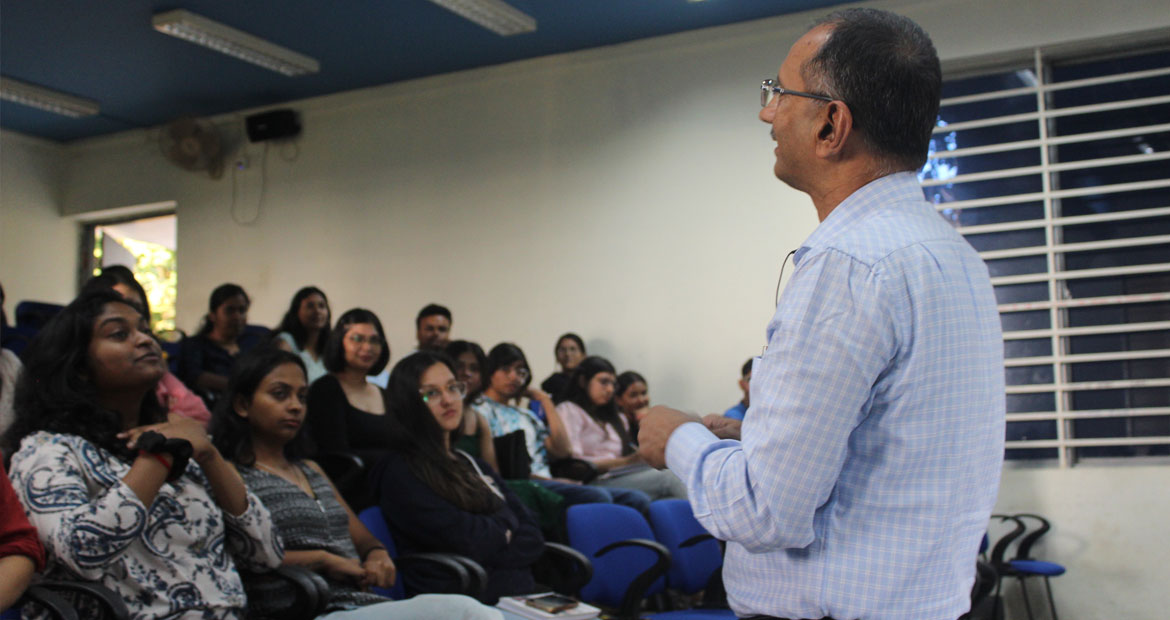
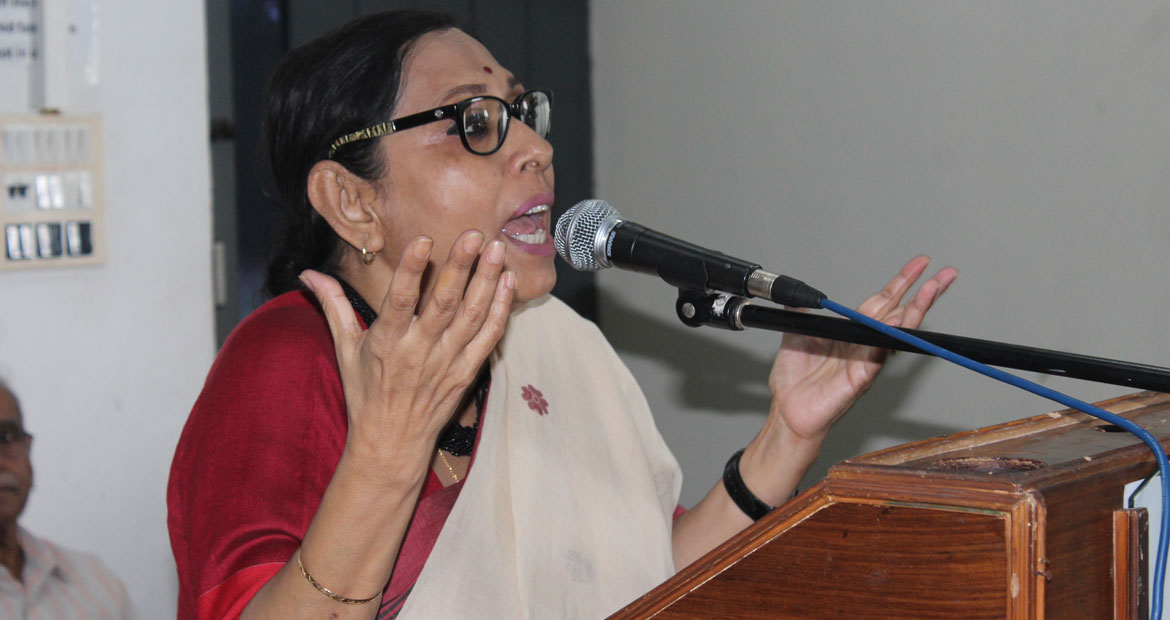
Journalists need to be able to clearly distinguish between their professional and personal personas on social networking sites in order to be objective, said Abi Sekimitsu, Editor Reuters, Bangalore.
Ms. Sekimitsu was speaking at the inauguration of the new academic year 2010 – 2011 at the Indian Institute of Journalism and New Media (IIJNM), Bangalore on Monday, July 12, 2010.
Citing several examples of how senior journalists had run into trouble simply because they had tweeted the news before embargo time or had tweeted their opinions, Ms. Sekimitsu said that we need to remember that we represent the public interest.
Journalists, just like celebrities, were now under microscopic scrutiny, she pointed out.
On the other hand, she said that there was little difference between local and global news. Local news is sometimes picked up by international agencies and becomes global news, thanks to technology, Ms. Sekimitsu said.
Ms. Sekimitsu urged the young trainees to be objective and accurate. She added that journalism was a profession like no other and they ought to be glad that they have taken it up.
Dean of IIJNM, Dr. Abraham M. George said that though the press does a lot of good, it also tends to miss stories. No media house had been able to predict the economic recession in the US though several experts had seen it coming, he said.
He urged the young trainees to ask uncomfortable questions of the powers-that-be and to find the truth.
IIJNM is an autonomous journalism school that offers a post-graduate diploma in Journalism in Broadcast, Print and Multimedia.
This year, the Institute has on its rolls two international faculty—Ron Feemster who has written for the New York Times and other newspapers, and Mark Austin who was with Japan’s biggest newspaper, The Yomiuri Shimbun, until recently. Their profiles are on the Institute’s website (www.iijnm.org).
Young Journalists Face an Ethical Challenge: Rajdeep Sardesai
BANGALORE, May 8, 2010—The real challenge for young journalists today is the ethical challenge, said Rajdeep Sardesai, President of the Editors Guild of India and Editor in Chief of IBN 18 Network. If they can measure up to this challenge, they can find a way of changing the profession, he said.
Mr. Sardesai was speaking at the Annual Convocation of the Indian Institute of Journalism and New Media (IIJNM, www.iijnm.org) here this morning.
What we have today is the journalism of short cuts, he said. It was a journalism of who got it first and not who got it right. “Get the story right,” he told the students, and it didn’t matter if it was ten minutes late, he added. It was for the young journalists to put the profession back on track he said.
There was so much information available in the world today, but no knowledge, Mr. Sardesai said. “More media does not necessarily mean better media,” he said. It was unfortunate, he pointed out, that we live in an era of sensationalism where “people like me, who should be giving you the right information are under pressure to hype up the information.”
He also condemned the media for declaring people guilty even before any court declared them so. Other challenges included the business of paid news, he said.
The real problem, he said, was not with young people who entered the profession with hope, but with the top people who end up compromising the ideals they themselves set out with. They are the ones who forget to tell young people things about privacy, about the truth, about telling the story as they see it, he said.
IIJNM Dean, Dr. Abraham M. George called the Graduating Class the future torchbearers of the free press. He urged them to report in a truthful, impartial and balanced manner, while at the same time, making it interesting.
He said that they must give importance to matters of national interest instead of telling stories that were sensational. He urged young journalists to be vigilant and not to be caught napping like the US press was during the sub-prime crisis. He said that they must question all governance—whether it was that of the official governments or of the private sector.
“Do not be afraid to challenge the politicians and bureaucrats, you should not be note-takers, but should ask them questions,” he said.
Seventy six students graduated this year, of whom 13 received honours and awards.
Graduating
Class of 2010
Outstanding
Students of the batch who placed on the
Parimal Vijay S S Outstanding Print & Online Journalism Student
Roll
of Honour
Divya Suryanarayan Excellence in Development Reporting
Gangadhar S Patil Excellence in News Reporting
Mrinmoy Bhowmick Excellence in Television Documentary
Saumitra Ranjan Chand Excellence in Radio Production
Sethuraman N R Excellence in Business Reporting
Shravya Jain Excellence in Magazine Writing
Siddharth Kotian Excellence in International Reporting
Dean's
List
(for
meritorious endeavours in journalism studies)
Chandan Singh
Rienke van Nieuwland
Roshan Kumar Mogali
Sneha Menon
IIJNM students work for Channel 4 on prestigious project
“It was an experience to reckon with as it helped me understand the diversity of opinions people have in the city on one issue,” said Bansi Mehta, a print student at IIJNM. Bansi was one of the 22 students of the Indian Institute of Journalism and New Media (IIJNM), Bangalore who worked in collaboration with UK based Channel 4 to produce a special programme on India.
The students had to find out what Bangaloreans think of certain topics in the news on a given day. These ranged from issues of the day to the hot sports topic of the day to the celebrity of the day. The results were then uploaded on Channel 4’s website.
“The students were really enthusiastic about the whole thing. Indeed it was a great opportunity for them to work with such a reputed channel like Channel 4. The programme was meant for the international audience, so it was a different kind of experience,” said Surekha Deepak, IIJNM faculty who coordinated the project.
Channel 4, too, appreciated the work done by the students. “Your students’ work was greatly appreciated and I would like to thank you and all the students and staff at the Institute for your help and participation in this experiment of cooperation. While we we're time restricted by events in Haiti on how much made the TV bulletin your students work greatly aided our website,” said Oliver King of Channel 4 news.
For the aspirant journalists, it was a great opportunity to showcase their talents before an international audience. “I enjoyed every moment of the job assigned by Channel 4 in interviewing people of Bangalore as part of India Winter season. Being a part of one of the leading TV News channel of the world, was a matter of pride,” said Mrinmoy Bhowmick, a broadcast student.
However, for a few, the experience was challenging. “It was tough to find people and make them talk during the office hours. One of the worst experience was to ask students to talk on camera when they had exams to appear for,” said Arnab Lal Seal, a student.
Some others, however, found the challenge exciting. They said that this would help them prepare for real-life situations. Chandan Singh, another broadcast student, said, “It was all about meeting strangers. At times I had to give them newspapers to read and they were willing to participate. The whole exercise of briefing, convincing, shooting was a fun-filled learning experience,” he said.
This experience with Channel 4 was indeed a learning experience for the students, especially the print students of the institution who are usually accustomed to a monitor, mouse and page-making software. “As a print student, I was a bit wary of using a camera. In the first few shots I took, the faces were distorted and there was no audio. But, it was a steep learning curve and soon my vox pop captured people walking horizontally (rock climbing) and tall people (the state volleyball team),” said Parimal Vijay S.S, another print student.
IIJNM Students participate in Global Media Monitoring Project 2009-2010
On November 10, 2009 IIJNM students joined monitors from 105 countries in a global effort to collect data on selected indicators of gender in their local news media. The GMMP is the largest and longest longitudinal study on gender in the world’s news media. It is also the largest advocacy initiative in the world on changing gender representation in the media.
The Fourth Global Media Monitoring Project took place this year involving participants ranging from grassroots community organizations, researchers, and media practitioners and for the first time, graduate students from selected colleges. IIJNM students from Print, New Media and Broadcast specializations were earlier trained in the research methodology and guidelines for carrying out the monitoring exercise.
November 10 was D-day when monitors across the world got down to mapping media representations of women and men in news stories of the day in print and broadcast media. Our students were a part of the Karnataka contingent assigned to monitor English and Kannada newspapers and news channels in both languages.
The study is designed to provide gender and communication activists with a tool to lobby for more gender-sensitive communication policy in their national and regional contexts. The results of the Fourth GMMP will be published in time for key global processes scheduled for 2010, including the Beijing +15 review and the Millennium Development Goals Review Summit.
RTI more revolutionary than taking up a gun: Aruna Roy
Though India’s Right to Information Act is approaching its five-year anniversary, the campaign to push for government transparency and active use of the system must run parallel with each other to achieve the greatest effect, according to one of the initiators of the RTI movement, Aruna Roy.
As a guest lecturer at the Indian Institute of Journalism and New Media (IIJNM, www.iijnm.org), Roy narrated anecdotes from her campaigns in rural Rajasthan, where she continues to work for Mazdoor Kisan Shakti Sangathan (MKSS). The non-party political organization was in the forefront of the movement in 1990s that inspired the RTI Act. Roy emphasized that the right to information is linked to the right to life; it is more revolutionary than taking up a gun and fighting.
Five years after it became a law, the RTI act has created unprecedented dialectics between the individuals and government officials, and has created a climate in which honest and enabled people can step out and say something in the public domain, Roy said.
Roy is currently working with other national groups in the campaign against Special Economic Zones, or SEZs. The SEZ act, which she pointed out was passed without debate by the same parliament that passed the RTI, has allowed lands to be taken away from farmers and tribal people, subsequently denying their rights as citizens. In addition, once created, the SEZ are exempt from many labour laws and tax laws, creating a deficit in the state treasury, she said. As a result, many SEZs have even grown into land estate development projects, benefiting only the owners, Roy added.
Just as the public was amassed to push for India’s Right to Information act, the country must also mobilize to fight against the corruption of SEZs, she said.
Students
must use the RTI
Bangalore,
August 14, 2009 : "Students should make use of the RTI,"
said Shekhar Singh, co-founder, National Coalition for People's
Right To Information, at ‘State of the RTI,’ a seminar
organized by the Indian Institute of Journalism and New Media (IIJNM)
here this morning.
Students from various colleges attended the seminar.
Dr. Singh talked about safeguarding the right to information and
described how the law was drafted to catch corrupt people in government
departments. He presented the findings of a recent, nationwide survey
conducted by his group. The survey tested the knowledge and use
of the RTI by more than 35,000 citizens in 10 states, and filed
more than 800 RTI requests to determine government responsiveness.
The
seminar had several panelists discussing the state of the RTI. Mr.
Virupakshaiah Commissioner, Karnataka Information Commission, responsible
for handling RTI appeals and complaints by citizens against government
officials pointed out that the state has only two Information Commissioners.
“With the number of cases pending in the files, we need more
infrastructure and more people to handle it,” he added. He
said that almost 6000 cases were still pending. The Bruhat Bangalore
Mahanagara Palike (BBMP) and the Bangalore Development Authority
(BDA) had the maximum cases filed against them.
Parvathi Menon, Bureau chief of The Hindu, Bangalore,
talked about the role of media in the context of spreading awareness
regarding RTI. "The media today needs to change its mindset,”
she said, adding that daily deadline pressures left little space
for long-format investigative stories.
Y G Murlidharan, Consumer Advocate, Director, Consumer Rights Education
and Awareness Trust (CREAT) shed some light on the efforts of bringing
about some transparency at the village-level by two model villages.
Pointing
out to the statistics that showed how the English language media
was more active in propagating RTI then the vernacular media, another
panelist, Theodore Bhaskaran, a historian mentioned how it took
two years to get the Tamil version of the RTI act.
"One has to fight for their right to get information at every
step, you just can't give up at any point", asserted Jayashree
JN, Founder of "Fight Corruption Now", who made use of
RTI to root out corrupt officials in the administrative offices.
IIJNM alumni who had produced investigative stories
using the RTI talked about their experiences with using the Act.
The seminar was moderated by IIJNM Visiting Professor and Pulitzer
Prize finalist, Ralph Frammolino.
Media vulnerable to ad pressure
Bangalore,
July 20, 2009— Mr K N Shanth Kumar, Director, The Printers
(Mysore) Ltd and Editor-in-Chief of Prajavani, said the heavy dependence
of the media on advertising support was making it vulnerable to
pressure from the government as well as the corporate sector. Launching
the new academic year (2009-10) of the Indian Institute of Journalism
and New Media (IIJNM) in Bangalore, Mr. Shanth Kumar told
the new batch of students that keeping the price of newspapers low
forced managements to depend on advertising revenue. “This
makes newspapers sensitive to needs of advertisers,” he said.
The Prajavani Editor-in-Chief stressed on the importance
of journalism training. He said untrained citizen journalists could
supplement professionally trained journalists but never replace
them. “Citizen journalism has its limitations,”
he said.
Mr.
Shanth Kumar lamented the fall in standards in the knowledge and
use of language among journalists. He said unless journalists had
a good command over language they would find it difficult to report
comprehensively and convey information effectively.
Welcoming the new batch of students, Dr. Abraham
M George, Dean of IIJNM, said journalism these days pays well but
carries enormous responsibility towards society.
The Indian Institute of Journalism and New Media
(IIJNM) is an independent journalism school that offers a post-graduate
diploma in Journalism. IIJNM offers diploma in four streams: Print,
Television, Radio and Online Journalism.
Students at IIJNM are given hands-on training in journalism, regardless
of the stream they choose. Print students bring out a weekly newspaper,
broadcast students a weekly news bulletin and online journalism
students maintain their own news-based website. The students have
a real-life experience of the world they plan to enter on graduating
from the portals of the IIJNM. The new batch consists of 82
students.
An
exciting time to enter journalism-Shekhar Gupta
Bangalore,
May 2, 2009- There couldn't be a more exciting time to be entering
journalism than the present one, said Mr. Shekhar Gupta, Editor-in-chief
of The Indian Express at the convocation ceremony at IIJNM this
morning. He added, real-time media is a tyranny for those in power.
Recalling that the emergency had been called the
worst time for young journalists, he said that there was a journalism
boom immediately after the Emergency. That, he said was the golden
age of the Indian media.
The second golden age of the media will be out
of this crisis, Mr. Gupta said. This crisis will wipe out the large amounts
of space that we have for the average, the mediocre and the below-mediocre.
Competence levels will go up, he said, adding that journalism has
as many incompetent people and scamsters as has any other profession.
All talk of the demise of print journalism as we
know it today is all noise, Mr. Gupta said, adding that the newsroom
was going to be redefined with the introduction of competent, digitally-savvy
journalists.
Exhorting young journalists to be curious, he rated
curiosity as the essential quality for a journalist. He also asked
young journalists to be more opinionated in the news room, than
in their stories, to see everything as a story, and to uncover what
those in power don’t want to cover.
Accuracy, fairness and credibility have become all
the more important
today, he said, calling citizen journalism ‘baloney.’"Show
me a citizen lawyer or a citizen doctor and I'll show you citizen
journalists," he said, adding that journalism is as much a
profession as any of the other two.
In his address, Dean Abraham M. George asked the
students to make the clear distinction between fact and opinion;
be persistent enough to dig into the story and uncover what is important
and inform and engage the reader as best as possible.
After the graduating students received their post-graduate
diplomas in television, radio, print and new media, some of them
were honoured for having excelled in various fields.
Graduating
Class of 2009
Outstanding
Students of the batch who placed on the
Roll
of Distinction
Manasi Milind Phadke Print & Online Journalism Student
of the Year
Brenton Joseph Cordeiro Television Journalism Student of the Year
Roll
of Honour
Anirban Sen Excellence in News Reporting
David William Besseling Excellence in Covering Arts and Culture
Deepika N. Bharadwaj Excellence in Television Documentary
Dilraz Kunnummal Excellence in International Reporting
Manasi Milind Phadke Excellence in Development Reporting
Samarth Saran Excellence in Political Reporting
Dean's
List
(for
meritorious endeavours in journalism studies)
Krishna Merchant
Pavan Kumar Hubli
Sudarshan Kumar
Tasneem Balapurwala
IIJNM students
use RTI to find BMTC recycling deadly drivers, the cost of
CM temple visits, other stories
BANGALORE, April 30, 2009—Less than one per
cent of the Lokayukta corruption cases close with convictions. Government
school teachers go on leave for years without being replaced. BMTC
fires only 10 per cent of drivers who’ve caused fatal accidents
and puts the rest back behind the wheel. Chief Minister B. S. Yedyurappa
spent close to Rs. 11 lakh of public money for his personal spiritual
endeavors.
These
four seemingly unrelated stories were bound together by the Right
to Information (RTI) Act used by student journalists belonging to
the Indian Institute of Journalism and New Media (IIJNM, www.iijnm.org).
They were revealed at a press conference this morning and are available
on the Institute’s website, www.iijnm.org/investigations.
The student projects were completed under the guidance
of Ralph Frammolino, visiting professor for print. A veteran Los
Angeles Times reporter and co-finalist for the 2006 Pulitzer Prize
for Investigative Reporting, Frammolino came to IIJNM in July for
one year. He conducted the investigative reporting class as an “I-team,”
taking students through projects that examined major Bangalore institutions.
These investigative efforts showed how difficult
it still is to get information from the agencies under the RTI Act.
The Chief Minster’s office was most uncooperative
with the requests. Eighteen officers made the students go from one
table to another 72 times before they gave the information.
In
the case of the BMTC, an RTI request had been filed in November
with the Assistant to the Principal Information Officer. When no
response came within a month, the students had to file another,
which again got no response. They then filed an appeal which got
things moving. After that, however, they had no trouble getting
access to information.
The Department of Public Instruction, too, took
about three months to give the information the students were seeking.
Eventually, they got the names of only 10 absentee teachers, when
they had asked for about a hundred.
The corruption watchdog, Lokayukta, was probably
the most cooperative under the RTI. The students were given all
the information they sought.
The student projects and their findings:
While promising to weed out reckless drivers,
BMTC officials have quietly recycled their most deadly ones, responsible
for nearly 370 fatal collisions since 2000. In 28 cases, drivers
given another chance went on to cause a second, even third fatal
accident before they were fired. BMTC officials say they don’t
immediately fire drivers because, among other things, it would
hurt employee morale.
Karnataka education officials responsible for
overseeing government schoolteachers have allowed some to go AWOL
for years without purging them from the employment rolls. IIJNM
Students found one ghost teacher in three hours.
The public paid Rs. 11 lakh to send Chief Minister
BS Yeddyurappa, on eight “official” temple visits
during the first months of his tenure.
Lokayukta Santosh Hegde whips up the publicity
when he traps or raids public officials. But he is silent about
the track record of his office: Less than one per cent of all
complaints and traps result in verified punishments.
The RTI was introduced to help the public track
the functioning of government bodies. But the studies show that
the governing bodies are reluctant to give full disclosure, though
they are legally bound to do so under the act.
IIJNM’s
Annual Convocation will be held on May 2, 2009. The convocation
speaker this year will be Mr. Shekhar Gupta, Editor-in-Chief, The
Indian Express.
IIJNM will be happy to host Mr. Gupta once again.
He had inaugurated the Institute in 2000. In his inaugural address,
Mr. Gupta had, like any good journalist, displayed skepticism about
the quality of journalism schools. A decade later, we’re sure,
Mr. Gupta will be happy to see that IIJNM is undoubtedly the premier
journalism institute in India with the best infrastructure, excellent
faculty and a vibrant, dynamic curriculum.
Mr. Gupta has been with the Indian Express for several
years, off and on. He has been responsible for breaking several
stories in the Express. He exposed the Nellie massacre in Assam
as a young reporter before moving on to join Indian Today, where
he again covered path-breaking stories like the role of the intelligence
agencies in what came to be known as the ISRO spy scandal. He also
uncovered LTTE training camps in India.
Mr. Gupta hosts a weekly programme on NDTV 24 x
7, called Walk the Talk where he interviews personalities on the
topic of the time. His weekly column, National Interest deals
with an eclectic list of subjects and is widely read.
He has been a regular speaker at the World Economic
Forum. The Indian Express won the Vienna-based International Press
Institute’s first India Award for Outstanding Journalism in
the Public Interest.
The convocation marks the end of a hectic academic
year at IIJNM. Graduating students are given diplomas. Students
on the Roll of Distinction, Roll of Honour and the Dean’s
List are given awards.
Global Experience in Journalism
Studies
As the sweep of “Slumdog Millionaire”
in this year’s Academy Awards amply underscored, the story
of modern India is a riveting and inspiring one.
With a teeming population of 1.1 billion people, the world’s
oldest culture and its biggest democracy embraces the worst and
best of humanity. But most of all, it has become a land of personal
and economic miracles—miracles that are already remaking the
subcontinent one of the dominant forces of the 21st Century.
And
one of those fields of dominance is the media. India has not only
become an incredible news story, it is pushing the frontiers of
print and broadcast journalism. While America’s newspapers
are downsizing and dying, they’re proliferating in India,
where a dramatic rise in the literacy rate is creating millions
of news-hungry readers every year. Meanwhile, broadcast channels
are multiplying even as cyber entrepreneurs launch Websites to tap
into the zeal of citizen journalists, many of whom have turned into
local Woodwards and Bernsteins by using the country’s new
Right to Information Act to watch over government spending and misdeeds.
All facets of the media—print, broadcast, the Web—are
robust in India, where a steady increase in literary rates and the
recent economic boom has created millions of new readers and viewers.
Meanwhile, the ties are growing stronger between the media industry
and academia in India and the United States. Indian media houses
are starting to hire students from American universities, while
Indian journalism schools are inviting American professors and professionals
to teach.
As never before, India needs highly trained and aggressive young
journalists. And the Indian Institute of Journalism & New Media
has dedicated itself to meeting that need through its unique one-year,
Master’s level residential program. The strength of the IIJNM
program is that it uses its hometown of Bangalore, India’s
Silicon Valley, as the real-life laboratory for all reporting assignments.
As a result, IIJNM students and graduates are prepared to rise quickly
to the top of the profession.
For instance, four out of the ten students who qualified for the
prestigious CNN Aspiring Journalist Awards last year were from IIJNM.
The Institute also boasts the first graduate of any journalism college
in India to be hired for a New York Times internship as well as
the Scripps Howard internship in Washington D.C. Many have found
jobs with such highly respected media outlets as the United Kingdom
Press Association, Reuters, the Times of India (the world’s
largest circulation English daily), and CNN-IBN, the nation’s
premiere 24-hour news television channel. These are just a few.
You see IIJNM alumni all the time on television; you read their
bylines in newspapers, magazines and websites; and you listen to
them on radio.
“What I liked about my year at IIJNM was that I was given
the freedom to choose news stories I wanted to work on, and excel
in whatever I was doing,” says Deborah Grey, now at CNN-IBN,
India’s leading 24-hour news channel.
Prospective bosses are very pleased as well.
“We are happy customers,” declared Piyush, Executive
Editor at ANI, which has employed five IIJNM students. Added A.V.S.
Namboodiri, Senior Associate Editor at the Deccan Herald of Bangalore:
"Your students are well-trained."
IIJNM offers first-rate facilities on a modernist campus, equipped
with broadband, a television studio, video editing labs and a computer
lab. The curriculum has been developed in association with Columbia
University’s Graduate School of Journalism.
Most importantly, it offers personalized instruction from a cadre
of full- and part-time faculty members that have included Fulbright
scholars; Knight Fellows from the U.S., Europe, Cambodia, Egypt
and Bangkok; a Pulitzer Prize finalist; the lead business journalist
on the Union Carbide tragedy in Bhopal; one of India’s foremost
experts on developmental issues; the creator of Al-Jazeera’s
immensely popular Website and a number of former print reporters,
editors and broadcasters with decades of experience in the Indian
media. Guest lecturers have included Thomas Friedman, columnist
for The New York Times, and Susan King of the Carnegie Foundation.
Under the faculty’s guidance, students are drilled on the
practical aspects of newsgathering, a decidedly daunting task in
India. Unlike other Indian journalism schools, which teach mainly
theory, IIJNM shuttles students two days a week to Bangalore for
on-the-ground story assignments. Upon their return, they churn out
stories that find their way into the campus newspaper and, in a
few cases, into the mainstream press. In 2008-2009, IIJNM print
students had articles in The Hindu and the Deccan Chronicle. Publication
isn’t limited to students; one of IIJNM visiting faculty members
wrote about India’s Right to Information Act for the Jan/Feb
2009 Columbia Journalism Review.
The results of IIJNM’s approach are obvious. The school has
enjoyed nearly universal success placing its students in professional
jobs. For American students, that would translate into a second
chance to work, a chance to enter a media market that is expanding
rather than contracting. But there are other rewards, as well. In
addition, American students would enjoy a year-long, cross-cultural
feast, one that will help them build an international network as
they pursue their journalism careers in tomorrow’s interdependent
world.
Celebrated as it was, Slumdog Millionaire was sheer fantasy. But
journalistic opportunities at IIJNM for the adventurous foreign
students are reality at its best.
For further information or admissions, visit www.iijnm.org.
Tel.: +91-80-2543 2565 / 2543 2575
WHAT'S THE MEDIA
UP TO NOW?
Plenty.
As the country prospers and gains global clout, the next generation
of Indian journalists will face challenges beyond covering crime,
broken sewers and Bollywood.
Tomorrow's reporters will have to understand and
interpret sophisticated issues dealing with the environment, political
reform, poverty and communal equality. And they'll have to tell
their stories at lightning speed across new technological platforms
reaching audiences steeped in visual literacy.
Whether you are a future journalist or a consumer
of news, you will be affected. Find out how through a series of
free public lectures given by faculty from the Indian Institute
of Journalism & New Media. Find out what the Indian
media is up to now.
The right to know in a warmer
world
Prof. Nagesh Hegde Date: Saturday, November 29, 2008 : Time: 10.30 a.m.
Venue: Mount Carmel College Auditorium
RTI: The People’s Movement
Prof. Ralph Frammolino Date: Saturday, December 6, 2008 : Time: 10.30 a.m.
Venue: Christ University Campus, Hosur Road
Go to
the Web!
Prof. Dakshina Murthy Date: Saturday, December 13, 2008 : Time: 10.30 a.m.
Venue: Christ University Campus, Hosur Road
Contact:
Indian Institute of Journalism & New Media
Telephone: 91-80-2543 2565 / 2543 2575 / 2544 0164 / 2544 4995
Mobile: 0-99809 22204; Fax: 91-80-2544 0210
Website: www.iijnm.org | Email: admin@iijnm.org
Business
journalism is exciting today
Bangalore,
July 14, 2008-The emergence of news networks run by journalists
has resulted in a big change in journalism in the country, said
Senthil Chengalvarayan, President and Editorial Director, TV18 Business
Media.
This could help
bring greater credibility to the media and enable it to withstand
pressures from various interests, he said.
He was speaking at the inauguration of the Academic Year 2008 -
09 at the Indian Institute of Journalism and New Media (IIJNM) here
this morning.
Giving the
example of the network that he worked with, he said that they recently
lost several crore-rupees of revenue in advertising because they
did hard-hitting stories about a company. However, the network decided
to take the stand it did because it wanted to put journalism first.
Indians are
doing a lot of business today and business journalism is a good
place to be in, said Senthil. A business channel today was the biggest
channel in the country, beating even popular, regular news channels,
he pointed out, explaining that business news was not just for the
business person, but for everyone.
Young
journalists, Senthil said, are entering the profession at an exciting
time, given that technology has opened up opportunities that were
hard to come by a few years ago.
IIJNM Dean,
Dr. Abraham M. George regretted that the press in the country was
not always asking the tough questions it ought to. He said that
a democracy could be strengthened only by its media and the Indian
media needs to rise up to the challenge.
The IIJNM began
its new academic year with nearly 60 students.
The Institute
has on its rolls two international faculty this academic year. A
Fulbright scholar and a Pulitzer Prize finalist will teach at the
IIJNM. View their profiles here.
IIJNM ANNUAL CONVOCATION 2008
The media enjoys public confidence: Vinod Mehta
Bangalore,
May 3—All our democratic institutions are in disrepair, but
the two that still enjoy public confidence are the media and the higher
judiciary, said Mr. Vinod Mehta, Editor-in-Chief of the Outlook group.
Mr. Mehta was speaking at the Annual Convocation
of the Indian Institute of Journalism and New Media (IIJNM, www.iijnm.org)
here this morning. Addressing the students, he said that they were
privileged to be journalists, especially at a time when people thought
that the media was one of the pillars of democracy.
Mr.
Mehta urged the students to be professional journalists and to become
familiar with the basic rules of the game. These included a need
to correct what is wrong and to be skeptical while avoiding cynicism.
While journalists cannot avoid having to work with
politicians and public relations people, they must not get friendly
with them, Mr. Mehta said. A journalist can still be professional
while dealing with these people on an every day basis he said, adding
that being friendly with them could lead to the journalist becoming
corrupt.
It was a good time to be in journalism just now,
Mr. Mehta said. He explained that working conditions of journalists
had improved tremendously, they got better salaries and newer technology
helped them work faster. The economic growth had fuelled more opportunities
for journalists today, he said.
Advising
the aspiring journalists to take up print, Mr. Mehta said that they
could learn a lot in print. Television journalism has no time for
detailed research he said because there is a need for instant gratification
and instant scoops in television in India today.
Describing sting journalism as a double-edged sword,
Mr. Mehta said that it should be used only when no other way could
be found to do a story. All the best scoops in the world were not
stings but well-researched stories, he said, giving the example
of the Watergate scandal.
In
his address, Dean Dr. Abraham George told the students to remember
that a free press was the voice of the people; it was one of the
main pillars of a strong democracy. He said that they must strive
for the ideals of social justice and economic fairness that India
had embraced when it became independent.
After the graduating students received their post-graduate
diplomas in television, radio, print and new media, some of them
were honoured for having excelled in various fields.
Graduating
Class of 2008
Outstanding
Students of the batch who placed on the
Roll
of Distinction
Gayathri Vaidyanathan Print & Online Journalism Student
of the Year
Vaishnavi Vittal Television Journalism Student of the Year
Roll
of Honour
Akansha Pradeep Excellence in Radio Documentary
Amiteshwar Singh Excellence in International Reporting
Dielle D'Souza Excellence in Magazine Writing and Production
Divya S Gojer Excellence in Television Documentary
Itika Sharma Excellence in Business Reporting
Shalu Yadav Excellence in Televison News Reporting
Sneha
Jha Excellence in News Reporting
Snigdha
Poonam Excellence in Development Reporting
Dean's
List
(for
meritorious endeavours in journalism studies)
Debasis Mohapatra
J Jagannath
Komal Chaudhary
Supriya Khandekar
Spotlight
- 14 Jan, 2008, EducationTimes.com
Alleviating poverty and journalism
education
Abraham M George, Dean, IIJNM, wants to churn out professional journalists with integrity. He tells Poonam Jain about issues plaguing the educational sector and the future of journalism, among many other things.
A professor, a social activist and a philanthropist, Abraham M George has been a force to reckon with. He migrated to the US over 30 years ago, but larger issues that needed redress brought him back to India in 1995. The importance of democracy and free press led to the creation of Indian Institute of Journalism& New Media (IIJNM), Bangalore. He also founded The George Foundation, a non-profit organisation, for the welfare of economically and socially disadvantaged people. His work in the field of environmental health was instrumental for the removal of lead from gasoline throughout India.
A graduate of the National Defence Academy, Kharakvasla, and an MBA, MS and PhD in business administration from Stern School of Business, New York University, Professor George, wears many hats. Apart from his work in India, he is also the chairman of eMedexOnline LLC, a medical diagnostic software company in New Jersey, USA. ,and Visiting Professor at NY-Stern Graduate School of Business. Authored three books in international finance, his most recent one is on the experiences of working in rural areas of Tamil Nadu, titled “India Untouched: The forgotten face of rural poverty”.
One can’t help but wonder if he is secretly bestowed with more hours packed in a day. He also serves on the board of International Center for Journalists, Washington DC, and also on the US board of Christian Medical College, Vellore. He is a member of the New York and South Asia Committees of Human Rights Watch.
How did you foray into the teaching profession?
The main motivating factor in my decision over eight years ago was to start a good journalism institution. It was my conviction that a free and independent press is essential for strengthening India’s democracy. Only through an investigative and fair press can the nation address issues of good governance.
What are the issues plaguing the education sector today?
In my conversations with owners and senior editors at media organisations, the impression I get is that there is a serious shortage of good reporters and editors. Further, many lack a clear understanding of the role of the press, the ethical standards that must be adhered to and the necessary skills required to be a great journalist. At IIJNM, we are striving to turn out our graduates who meet those requirements. We want our graduates to acquire something more than being good reporters– we want them to be professional journalists with integrity.
Can you comment on the importance of industry participation in the educational sector?
Journalism is in the great traditions of liberal arts education. Well trained journalists are able to make significant contributions to the society. Journalism education did not receive sufficient attention until recently. IIJNM is the first (and probably only) non-profit journalism college that is run privately and dedicated to quality education in the field.
What are the new developments taking place in the field of journalism?
Journalism today is an exciting field. It offers many new opportunities as more media organisations have sprung up in India. Hopefully, it will become even more competitive in the near future. Consumers of news are demanding better and fairer coverage of events and issues. As the profession receives more recognition, its stature is also improving. Practically all our graduates are absorbed by media organisations well before they graduate. Starting salaries have increased from barely Rs 5,000 per month in year 2000, to Rs 10,000-24,000 per month today, again depending on the media organisation and its location.
What are your contributions to IIJNM?
My main role as the Dean and founder of IIJNM is to provide IIJNM all the required financial resources and support to conduct an excellent academic program. To-date, there has been over Rs 8 crores in investment toward IIJNM. IIJNM has the best infrastructure, media labs and faculty of any journalism college in India. Further, we have established an association with Columbia University Graduate School of Journalism whereby Columbia has assisted us in developing our curriculum and provide guidance.
Can
you give us more information about the courses offered?
Our goal is to improve on what has been accomplished in the past
eight years. Today our program covers all journalism fields–
print (newspaper and magazine), television, radio, web and multimedia.
Our media labs are equipped with modern computers, advanced software
and high speed Internet connections. Our studios and editing stations
employ the latest technology and hardware. Our faculty comes from
the industry with wide experience. We want to build on these strengths
and offer programmes and activities that will enhance the quality
of our curriculum.
What is the
student strength and the student-teacher ratio at IIJNM?
In the current academic year (2008), we have 54 students. We are
building additional residential facilities now to accommodate up
to 100 students in the next academic year starting July 2008 (ours
is a residential programme). There are 14 full-time and part-time
faculty members– a ratio of less than four students per faculty
member. In addition, we have 2 foreign faculty members with wide
media experience. We plan to maintain a ratio below five between
students and faculty.
Can you mention some prominent guest lecturers visiting the institute?
There is a steady stream of guest lecturers at IIJNM. Among them some recent ones being Thomas Friedman, columnist for the New York Times, Nidhi Mahesh - Principal Correspondent, Times Now and Naazreen Bhura- Resident Editor of Asian Age.
Tell us about the placements IIJNM provides. How have the placements shaped up this year?
Campus recruiting usually starts in March. Our students have been recruited by practically all major English dailies, Google, ANI, Reuters, CNN-IBN, and others. Starting salaries have ranged from Rs 10,000 to Rs 24,000 per month (in 2008). One of our graduates was recruited by the New York Times– the first among any journalism college in India. Several alumni have won major awards.
What are the innovative teaching methods used at the institute?
Our main focus is in offering the craft of journalism– how to become a good reporter and editor. Hence, we require our students to go out to the city and elsewhere to cover the news two to three days a week. They return with their stories, radio recordings and TV tapes and work on them until late night to produce the news story for our internal publications. Many stories find their way into mainstreams newspapers. They use state-of-the-art technology, and explore cutting edge advances in media.
What are the future plans for the institute?
Our goal is to improve our curriculum offerings, attract good teaching staff from within India and abroad (we have had several Knight Fellows from the US) and keep up with modern technology in editing, video shooting, recording etc. We want to build closer associations with the journalism community in India and increase the job opportunities for our students. We are constantly working to meet the needs of the industry and improve the quality and stature of the profession.
Bangalore,
January 12, 2008: Be down to earth and realistic. Unless you
experience the moment yourself, you will never be able to capture
it on your camera, said Dr T S Sathyan, the renowned photojournalist,
at a seminar of digital photojournalism, held by the Indian Institute
of Journalism and New Media, here, today.
Senior photojournalist from The Hindu, K Gopinathan, and Editor
of the Bangalore edition of the Kannada daily, Udayavani, Dr R Poornima,
were also present at the seminar. The editor of Karnataka Photo
News, S Ramaswamy, also the professor of digital photojournalism
at the Institute, moderated the event.
Dr
Sathyan told the students not to play gimmicks with photos. He said
that a photographer should never get his subjects to pose for him.
Lay emphasis on the composition and the lighting- even in
the case of street photography- unless it is a fleeting moment,
he said.
Show your photographs to senior and experienced photographers
for their critiques and also readily accept them. Review your own
old photographs, he added.
K Gopinathan tipped the students on photojournalism. Make
the photograph as simple as possible. Let it be direct and convey
the message easily. Emphasize on your subject. Have a news sense
necessarily, he said. Gopinathan also advised the students
to be photographers first and then try to be photojournalists.
Dr
Poornima too insisted on the importance of having an interest in
photography as well as a news sense. You should have a third
eye, to be a good photographer and capture the mood right,
she said.
All the three journalists agreed that art is an integral part of
photography.
The seminar was followed by a question and answer session, between
the present and future journalists.
The Institute had an exhibition as well as competition of the photographs
captured by the students. The guests at the seminar gave away the
prizes for the winners of the competition.
The seminar concluded with enthusiastic students queuing for an
autograph of Dr Sathyan on his book, Alive and Clicking.
IIJNM
faculty gets Rajyotsava Award
Prof
Nagesh Hegde, who has been associated with IIJNM since its inception
was recently awarded Karnatakas highest honour, the Rajyotsava
Award, for his work in Environment.
Prof. Hegde
has been a consistent champion of environmental causes all his life.
Born in the extremely biodiverse sphere of Karnataka, the Western
Ghats, Prof. Hegde has an M.Phil in Environmental Science from the
Jawaharlal Nehru University, New Delhi. He taught at the Kumaon
University, Nainital before joining Prajavani (Deccan Herald group)
as Development Correspondent.
He wrote a series
of feature articles on environmental and ecological issues coinciding
with and contributing to the nascent environmental movement in Karnataka.
Many of his writings have become text book lessons in high schools
and universities.
Prof. Hegde
has authored more than a dozen books in Kannada on various facets
of science, environment and development. He was honoured by the
State Sahitya Academy and his work was selected for an anthology
of the best childrens' stories of the century.
Prof. Hegde
participated in the first Earth Summit at Rio, contributing as a
delegate.
Though he has
retired from active journalism, he continues to write columns and
contribute to Kannada journalism.
Good
journalism: the need of the day
The
Class of 2007-08 started on July 23 with Dr. Narendra Pani, former
Editor, Economic Times exhorting the students to do good journalism,
no matter what the circumstances.
Tracing the
history of journalism in the world and the country, Dr. Pani pointed
out that while journalism had its high points and nadirs, what stood
out finally were the good stories done over the years.
Fifty-three
students have joined the Indian Institute of Journalisms year-long
diploma program in Journalism, in the four streams-Television, Print,
Online and Radio. The students come from all over the country, from
places as far apart as Gangtok and Tirvanthapuram and Kolkata and
Ahmedabad.
The
inaugural boot camp had several activities and lectures by eminent
people. Among the speakers were Ms. Parvathi Menon, Chief of Bureau
of The Hindu, Bangalore, Vijay Grover, Chief Editor, Zee TV Kannada,
Bangalore, Gauri Lankesh, Editor, Lankesh Patrike, Bangalore, and
Dr. Unnikrishnan, Emergenices and Human Security Advisor (Asia),
ActionAid.
The students
field trip to Bangalore lasted a little over two days. It was structured
like a treasure hunt, where students had to go to different places
and find answers to a list of questions they were given.
The students
enjoyed their first beat into town and overcame bad
weather, indifferent officials and tight security arrangements to
get the information they were supposed to. At the end of the activity,
they were treated to a scrumptious lunch at one of the Citys
famous traditional restaurants.
Journalists
must find a balance, says Sir Mark Tully
Bangalore,
June 20, 2007. Journalists must find a way of imposing some sort
of control on themselves if they are not to become the "feral
beasts" British Prime Minister Tony Blair called them, said
Sir Mark Tully, former Chief of Bureau, British Broadcasting Corporation
(BBC), New Delhi. Sir Mark was speaking at the Annual Convocation
of the Indian Institute of Journalism & New Media (IIJNM) here
this morning.
The media is
behaving like a wild beast, Sir Mark said, pointing out that reporters
are running wild, because they are under pressure, with no time
given to them to respond in a balanced manner. They show the bloodiest
pictures, the angriest people they can find, all to hype up news,
he said, adding that they resent the thought that they ought to
be censored.
Making
it clear that censorship did not work, Sir Mark said that while
one must not give any quarter to the government to censor journalists,
the media must not behave in a manner to force the government to
censor it. The editorial function, Sir Mark added, had been surrendered
today to a large extent to commercial interests who care little
for balance. "If we stood together like a proper profession,
we could fight them," he said.
He had little
to say about interactive news and television. It was a little like
"riding a donkey and getting kicked," Sir Mark said, adding
that while it was a good thing to have readers involved in the news,
allowing them to dictate news values was another altogether.
Warning against
the unimpeded use of technology, Sir Mark said, that it allowed
for far too much irresponsible live broadcasting which left the
viewer confused.
Exhorting
the Graduating Class of 2007 to continue learning while they are
in the profession, Sir Mark said that while journalists must report
in a balanced and accurate manner, they must also cultivate the
crucial virtue of humility. They must remember that the story was
not their story but the story of the person they are writing about.
They must also remember that that person is a human being and it
is not up to them to sensationalize or crucify him or her. Journalists
also need courage, a simple style of writing and a culture of reviewing
their work in daily meetings, Sir Mark said.
In his address,
Dean Abraham George told the students to remember that a free press
is the voice of the people; it is one of the main pillars of a strong
democracy. He said that they must strive for the ideals of social
justice and economic fairness that India had embraced when it became
independent.
After the graduating
students received their post-graduate diplomas in television, radio,
print and new media, some of them were honoured for having excelled
in various fields.
Graduating
Class of 2007
Outstanding
Students of the batch who placed on the
Roll
of Distinction
Anna Issac Outstanding Television Journalism Student
On
a hot afternoon with temperatures soaring above thirty degrees,
what would you imagine a bunch of soon-to-be journalists doing -
typing away on word documents, making pages, shooting bulletins
or running helter skelter to meet dead lines? Not even close. This
bunch of almost-there journalists came together to sweat it out
and plant tree saplings in the stretch of road between the college
and the hostel.
Professor
Nagesh Hegde inaugurated the event by planting the first sapling,
followed by enthusiastic students who spent all day digging holes
and preparing the ground for the saplings. Post- lunch everybody
gathered and guided by Ms Shobha from Alt tech Foundation and her
team, students planted one tree each. The avenue trees were planted
along the road divider and the spacing was
planned in advance. Teachers and students all worked together, and
were helped by the gardener Muthapa and the other administrative
staff (a.k.a the akkas), who were delighted to see everybody huff
and puff while working under the scorching sun. All the students
planted a tree each, and promised to take care of it till the end
of the semester .
Some
people say that earth day, environment day, earth week and the likes
are all just excuses for people to give speeches and organize pointless
programs but this Earth Week inspired a group of teachers and students
at IIJNM to plant trees. While journalists and common people are
all talking about the possible effects of global warming, this bunch
of enthusiastic students decided to take that a little further.
For all those who are all enthused with the front page broadsheet
coverage that the environment is getting, and the all new event
of a green story running as a flyer in several national dailies-
going ahead and planting a tree meant that we can do all that we
seem to preach in our development classes.
Dean
George is recipient of NYU Sterns Satter Social Entrepreneur
of the Year award for 2007
Social
entrepreneurship offers society the perfect marriage between tough-minded,
bottom-line realities and the passion that goes beyond creating
an economic profit. This is a marriage that excites me and has inspired
me to support this new program at Stern.
These are Stewart
Satters words in NYU Sterns Berkley Center for Entrepreneurial
Studies magazine, The social entrepreneurship pipeline: educating
and accelerating emerging social entrepreneurs states. The Satter
Award honors a Stern affiliated social entrepreneur who has leveraged
his or her Stern education to create innovative solutions to the
worlds most intractable social problems.
The magazine
goes on to say, We at NYU Stern think a great deal about how
business can be a transformative force for social good. This
is what Dr. Abraham George has always shared with the officers and
staff of The George Foundation and particularly, with the children
of Shanti
Bhavan.
On the evening
of April 12, 2007, at a well-organized Cocktail Evening in a hall
at NYU Sterns Berkley Center for Entrepreneurial Studies,
New York, Dean Thomas Cooleys opening remarks stressed the
universal desire of everyone present to build better societies.
He applauded Stewart Satters personal interest and support
of this humanitarian cause. Against a backdrop of slides of the
children taken during Dean Cooleys visit to Shanti Bhavan,
Dean Cooley mentioned that visiting Shanti Bhavan was a great
moment in my trip to India. He went on to say, It was
the most inspiring, memorable and exciting part of my trip.
Dean Cooley related his personal experience of the energy,
warmth, openness and intelligence of the children. He said
the other projects of The George Foundation displayed a range
of ideas and that the whole mission was a creative undertaking.
Stewart Satter
said, It is with great admiration and respect that he
presented Dr. George with the Satter Award in the presence of Dean
Thomas Cooley, and assembled guests, including Mrs. Mariam George,
wife of Dr. George, and their sons, Ajit and Vivek, Lalita Law,
Principal of Shanti Bhavan. Professors, students, social entrepreneurs
administrators and supporters applauded Dr. George on the occasion.
This well-deserved recognition of Dr. Georges work through
The George Foundation in Southern India could not have occurred
in a better setting. There is no greater feeling of accomplishment
than to be recognized by ones Alma Mater.
While thanking
Dean Cooley, Stewart Satter and the invited guests, Dr. Georges
response also embodied his belief and conviction in the empowerment
of the rural poor by providing job opportunities through business.
He said the rural poor do not need handouts. They want work. It
is the responsibility of the business entrepreneur to ensure their
workers safety and fair wages. Dr. George said only vibrant
economic activity can solve the problem of poverty. The rural sector
offers opportunities for businesses to make money while doing social
good. With rural economic activity and employment, the poor will
be able to afford food, shelter, healthcare and education.
As a closing
remark, Dr. George shared four of the Shanti Bhavan childrens
insights about the symbolism of common objects in relation to their
individual lives. One child said a piece of stone symbolized her
mothers love for the family because the mother broke stones
to earn a living. Another said a bicycle represents the means to
traverse a path that may go in any direction, just as the opportunity
to be educated at Shanti Bhavan provides an opportunity to make
something of their lives. A third child said a weed represents the
tenacity of sticking to ones convictions or holding ones
ground even if others try to uproot you. A fourth child showed a
handful of sand that represented the poor millions but also the
many who reach out to help and support them in the background, and
whose faces might never be known.
The Satter Award
ceremony at NYU Stern was memorable for its gathering of genuine
people who strive daily to support innovative ventures that make
the world a better place.
Media
Critic and editor of thehoot.org, Sevanti Ninan advised young journalists
to go the extra mile in getting a story.
Delivering the
Convocation Address at the Indian Institute of Journalism and New
Media here this morning, Ms. Ninan said, that going the extra mile
is conscientious journalism. There are often more than two
sides to a story in a society as complex as ours, she pointed
out.
She also suggested
that if young journalists did not see an outlet for the kind of
work they wanted to do, they must create it. The Internet, she explained,
makes solo publishing eminently possible. She recalled
that she was forced to create the Hoot because the outlets for writing
on the media were limited.
Film makers
with oppositional viewpoints who could not find a space for their
films ought to create a cooperative and launch their own channel
she said. The cost of hiring a transponder had come down, she pointed
out, adding that national and international NGOs were ready to fund
alternative media. With a little gumption, film makers in
India should have been able to create a documentary channel which
cable or DTH bouquets will be willing to carry, she said.
Exhorting
young journalists to be aware of ethical issues, Ms. Ninan pointed
out that technology was creating new ethical dimensions for the
media. You can digitally change the background on televised
news stories, she explained.
Media, she stressed,
had a responsibility to keeping a window open on the less palatable
realities of the hinterland. It had to be oppositional and it had
to shun the business of narrow coverage. If it did not, it had no
business taking advantage of the different kinds of concessions
given to the industry because of its public service nature.
Current journalism,
she criticized, was soft. And, that meant that the PR industry in
the country was doing its job well while journalists were failing
somewhere.
In his address,
Dean Dr. Abraham M. George hoped that the students would maintain
personal integrity, ethics, discipline, hard work and determination
in their professional lives.
Vice Dean Thomas
reminded the graduating class that there was nothing worse for a
journalist than losing credibility. The society you serve,
places often unrealistic expectations on you to tell the truth,
he said, adding that purveying a lie, even a little lie, is no escape.
You get caught for what is wrong, however small, he
warned.
After the graduating
students received their post-graduate diplomas in television, print
and new media, some of them were honoured for having excelled in
various fields.
Graduating
Class of 2006
Outstanding
Students of the batch who placed on the
Nishu Chaudhry Outstanding Television Journalism Student
Roll
of Honour
Amit Bhosale Excellence in Television News Reporting
Anusha Jha Excellence in News & Feature Writing
Jeanette Rodrigues Excellence in Business & International Reporting
Madhurima Duttagupta Excellence in Magazine & Feature Writing
Sophia Kikon Excellence in News Editing & Production
Vishank Choudhary Excellence in Television News Reporting
Dean's
List
(for
meritorious endeavours in journalism studies)
Vaishnavi Ramakrishnan
Nimish Pratap Singh
Appointment
of Vice Dean at IIJNM
Prof.
John Thomas, until recently Editor-Operations, Vijay Times,
and Visiting Faculty, IIJNM has just taken over as Vice Dean.
John comes to
us after 34 years of practice in India at Deccan Herald, Indian
Express, Statesman and Vijay Times, and Reuters, Agence France-Presse
and Business Times abroad. His past work has taken him through a
variety of roles from sub-editor, reporter, foreign correspondent,
news service head, commentary and editorial writer to being a special
projects man and media technology evangelist. He has also had brief
academic involvement with two other journalism colleges in India,
in addition to his recent part-time association with IIJNM. John
brings a wealth of journalistic understanding and practical experience
to benefit our student body and faculty.
We welcome him
aboard.
Make a difference!
One-Minute Video Contest
IIJNM Television faculty Nikhat Aslam has edited a 1 minute video,
'Vanaja's Story' for the CWC (Concerned for Working Children, Bangalore)
and has been chosen as one of the ten finalists in the Voices
of Youth ' Make a Difference' one- minute video contest. This
contest, which was organised by UNICEF, aimed to find the video
that best captured the mission of Voices of Youth - to promote and
protect every child's right to know, say more and do more about
the world they live in. The video is a gripping account of how Vanaja,
a poor and marginalised girl, fought against all odds for her right
to housing in her hometown in Karnataka, India.
'Vanaja's Story',along
with the other 9 finalists, will be available for broadcast in celebration
of the International Children's Day of Broadcasting celebrated on
11 December 2005.
'Vanaja's Story
was the only entry from Asia to appear in the Top 10.
IIJNM welcomes
the new batch of students (2005-06)
Nature
seemed to be at her best that Monday morning when the new batch
walked into the IIJNM campus. The sun was playing hide and seek
with the clouds and the wind was gently swaying the trees. It was
as if a show was being put up for the nearly 30 students as they
walked insome with their hearts in their mouths, others with
a song on their lips.
As usual, the
batch is representative of the country. Students come from places
as far apart as Sikkim and Chennai; Mumbai and Kolkata. We even
have a foreign student from the US, who'll be joining us shortly.
But even before the week is out, they've made friends and have become
a well-knit group.
"I reached
IIJNM with a pile of doubts and apprehensions," recalls Nishu
Chaudhry from Uttar Pradesh, "but they all vanished on my first
day at campus." Oasmita Chakroborty from Kolkata adds, "The
first thing that strikes you at IIJNM is the comfort level between
the faculty and the students."
Of course, the
ambience played a major role in putting the young minds at peace.
As Anshul Dhamija from Chennai puts it, IIJNM has the environment
to let one's poetic excellence come alive. "The majestic hills,
wafting cold air, plethora of fauna and flora, all entwine to give
a person the experience of God's Paradise," he says. Nishant
Bangar from Sikkim adds, "The campus is calm, peaceful and
very beautiful."
This peace and
calm was also the cause of some concern for a few. While Pavitra
Ramaswamy remarked, tongue in cheek, "we were going to learn
communication skills by cutting off all communications with the
outside world," Neetha Mahadevan worried about how she was
going to "manage here all alone, so far from the city."
Quickly, they've
all overcome their fears and doubts, and are getting down to business
and that does not mean journalism training alone. There's a lot
more to do, a lot more in store.
IIJNM celebrates
Annual Convocation 2005
June 24, 2005
"Get to the story," says Andrew Whitehead
Technology
has made journalists' lives much easier, but it has also made journalists
lazy, said Andrew Whitehead, Director, India, BBC World Service
Trust.
Mr. Whitehead was delivering the Convocation Address at the Indian
Institute of Journalism and New Media here this morning.
Exhorting the graduating Class of 2005 not to succumb to desk-bound
journalism, Mr. Whitehead said, "If you are reporting, get
as near to the action as you can. Getting there always gets you
a better understanding of the story. It also often gives you the
angle that you can make your own. It's what news journalism is about."
Pointing out that journalists' stories matter because they touch
on people's lives, Mr.
Whitehead remarked that sometimes reporters get so besotted with
the here-and-now, being so close up to the stories they report,
that they fail to make sense of them to their readers and viewers.
"Just because you know, don't assume your reader knows. Journalism
is about opening up public life, not about recycling information
within the elite," he said.
Mr. Whitehead added that the Indian media could do with more health
and environmental specialist reporters and fewer political reporters.
"Political stories are over-valued by news editors," he
said, adding, "We need more space for the big social themes-health,
education, environment, poverty alleviation."
Radio was another area where he hoped that India would follow Britain
and the US where radio news has been enjoying a resurgence.
In
his address, Dean, Dr. Abraham M. George, hoped that the graduating
class would uphold the values of democracy, freedom, liberty and
equality. He reminded them that they needed to question government
policies and programmes and work toward a fair and better society.
Sri Sri Sri Balagangadaranatha Swamiji, Founder Trustee of the B
S & G Foundation, graced the occasion and hoped that the graduating
class would live up to the great task of giving the correct news
to the world.
Associate Dean and Marshall of the Convocation, Professor Anand
Sagar took the Convocation through its paces, with a dash of Latin
to highlight the solemnity of the occasion.
After the graduating students received their post-graduate diplomas
in television, print and new media, the names on the Dean's List,
and on the Roll of Honour were announced. This year, a new category
was announced honouring the Outstanding Student in each stream.
The
students on the Dean's List (for meritorious endeavours in journalism
studies) were Anumeet Kaur Bedi, Mamita L. Setling and Merlin Flower.
Those placed on the Roll of Honour for Excellence in Reporting,
Editing and Production were: Abhirr V.P., Anushuka C. Rathour, Casey
Johnson, Rashmi Balakrishnan, Sohna Ravindran and Sreedhanya P.
Shanmugan.
The Outstanding Students in the three streams were: Deborah Grey
(Television Journalism), Anushuka C. Rathour (Online Journalism)
and Casey Johnson (Print Journalism).
Once the Valedictorian of the class, Deborah Grey, took over, a
lighter note was added to the ceremony. Casey Johnson shared his
thoughts through a video recording. Abhirr, as usual, had the audience
in splits. Sreedhanya, Tresa and Charmaine contributed to the cheer
and a touch of nostalgia. The youngest of the class, Mamita Setling
proposed a very well-spoken vote of thanks, bringing to a close,
the Convocation and the Academic Year 2004-2005.
Graduating
Class of 2005
Outstanding
Students of the batch who placed on the
Roll
of Distinction
Anushuka C Rathour (New Media)
Casey Johnson (Print)
Deborah Grey (Television)
Roll
of Honour
Abhirr V P
Excellence in Television News & Features Reporting
Anushuka C Rathour
Excellence in Online News & Features Reporting
Casey Johnson
Excellence in News & Features Reporting
Rashmi Balakrishnan
Excellence in Online News Editing & Production
Sohna Ravindran
Excellence in News Editing & Production
Sreedhanya P. Shanmugan
Excellence in Television Postproduction
Dean's
List
(for
meritorious endeavours in journalism studies)
Anumeet Kaur Bedi
Mamita L Setling
F Merlin Flower
IIJNM
sizzles
Casey
Johnson and Kavitha Vallath did IIJNM proud at the intercollegiate
debate on "Pin-ups and the Press" organized by the British
Deputy High Commission as a part of a two-day seminar (March 7-8)
on Media Law held at the Taj Coromandel in Chennai. The debate examined
the need and role of censorship vis-à-vis self-regulation,
in fighting the negative portrayal of women in the media. It was
a closely contested battle among four teams. Each team comprised
three members from a mix of journalism and law colleges from all
across South India. While Johnson was a part of the winning team,
Vallath's team was declared runner-up.
The
seminar, chaired by Joshua Rosenberg, legal editor of The Daily
Telegraph, covered diverse topics such as Freedom of Expression,
Right to Information, Contempt of Court, Defamation, Film Censorship,
and several other legal issues media persons often run into trouble
with.
The speakers
comprised the who's who of the journalism community in India. They
included N Ram, editor-in-chief of The Hindu, Naazreen Bhura, resident
editor of The Asian Age (Bangalore), Sushila Ravindranath, editor
of The New Sunday Express and BBC correspondent Sunil Raman.
Senior advocates,
Arvind P. Datar, Sri Ram Panchu and K. Chandru spoke lectured on
press law.
Dr. Kamal Haasan and Jeff Wilson, first secretary, press and communications,
British High Commission, New Delhi spoke on the changing roll of
the press in a global society.
Prof. Kanchan
Kaur accompanied the four-member IIJNM contingent, which also included
television journalism students Abhirr V.P and Deborah Grey. Some
of the other participating colleges were Asian College of Journalism,
Chennai, National Law School University of India, Bangalore, NALSAR
and Manorama School of Communication, Kottayam.
Mise-en scene
workshop
Bangalore, 7
February 2005: "Keeping the genre of cinema in mind, one decides
the Mise-en-scene," said Narendar Katkar, while conducting
a three day workshop at Indian Institute of Journalism & New
Media (IIJNM). A student of the French Etienne Decroux's school
of Mime art in Paris, and having worked with several ad agencies,
Mr. Katkar has now specialized in the Mise-en-scene technique of
filmmaking. He has taught this in several colleges and TV channels
all over the country. More details...
"India
Untouched" : Dean's book launched
"India
Untouched": An authoritative new book on rural poverty
by Dr. Abraham M. George, IIJNM Dean, was released by India's federal
Finance Minister P. Chidambaram at a well-attended book launch in
Chennai in September - following an equally successful book launch
in Bangalore in July. The function was attended by academics, senior
government officials, members of foreign diplomatic missions, the
media and others.
A major work
of public significance, India Untouched, addresses a range of complex
issues concerning India's continual problems of rural poverty, bureaucratic
mismanagement, political mis-governance and social injustice.
But as Ralph
Nader, the legendary American consumer advocate and environmentalist,
emphasises in his prefatory statement, it is "...A remarkable
story of what one man can accomplish with vision and determination".
Dr. George effectively
contradicts the widely held belief that rural poverty and social
deprivation in India are beyond redemption. The author's incisive
insights, coupled with a highly perceptive and prescriptive analysis,
gain much authority as his ideas for social and economic reform
are rooted in sheer pragmatism.
Dr. George,
a conscientious philanthropist, has devoted himself over the past
decade to working for the socio-economically underprivileged in
South India. He travels frequently between New York (where he is
based) and Bangalore (where he has established The George Foundation,
a not-for-profit organization) to carry out various humanitarian
and environmental projects.
A PhD in Business
Administration from New York University, he has previously also
authored three influential books on international finance.
IIJNM welcomes
the fifth batch of students (2004-05)
As
the largest batch at IIJNM, so far, trooped in on a bright Sunday
morning, you could see pairs of eyes shining with anticipation.
Some were a bit nervous, but others were quite ready to take on
the world. As Merlin Flower, who comes from Tamil Nadu, put it,
"I was impressed and scared, saw the garden and felt at home."
Sohna Ravindran from Kerala was a little unsure: "I remember
feeling an overwhelming sense of anxiety when I saw the Institute.
I wasn't sure of what I'd gotten myself into, but as the days passed,
I knew IIJNM was the best place to further my career prospects."
We have this
year, a batch of 23 students, which includes our first television
batch. Nine students have opted for the television course, six for
New Media and eight for Print. For some, IIJNM is a dream come true.
Says Jennita Catherine from Tamil Nadu, "Everything is so perfect
for the course-the infrastructure, the environment and the staff.
The students are so friendly. "Others, concentrate on more
important things. "The menu is great here," says Rashmi
Balakrishnan from Kerala, "everyone has to eat and drink (and
dream, too) words."
Making friends
quickly has been everyone's priority, A great place to live, learn
and befriend people, points out Barasha from Assam.
The architecture
and the ambience of the place has struck a chord with a lot. Says
Deborah Grey from Mumbai, "What completely captivated me was
the architecture. The ship like structure, the graded construction,
completely blew my mind. As for the peace and quite, well, I am
from a city that is home to 20 million people (Mumbai), so Kumbalgudu
was interesting only to an extent. What I love though is that this
place is a haven for marathon walkers like myself. You can also
go running! I love the college and the hostel accommodation. The
food is good too!"
Adds Anoushka
from Dehradoon, "The best part about IIJNM is its serene environment.
Its apt for studying and great for long walks!"
Long walks and
studying are just two of the items on the agenda. There is a lot
more, as you will see, to come.
IIJNM introduces
TV Journalism
IIJNM
is pleased to announce that we've expanded the curriculum to include
Television Journalism
in the academic year 2004-2005. Students learn to conduct television
interviews, write, and narrate stories in a variety of formats,
including: breaking news, news feature, documentary, and news magazine.
Students learn the techniques of shooting, and three of the widely
used video editing software. And also this course explores the management
structures, procedures, policies and goals of television news broadcasting
operations. It analyzes the technology and methods used in covering
news events, and the relationships with news consumers.
IIJNM
celebrates Annual Convocation 2004
15 June, 2004 Essayist
and historian Dr. Ramachandra Guha warned prospective journalists
to not be loyal to any political party lest they be
forced to compromise their integrity.
Guha, who was addressing the Indian Institute of Journalism and
New Medias graduating Class of 2004, offered several other
valuable tips in his soul-stirring speech that was generously peppered
with witticisms.
He told the students that among the eight rules by which
journalists should guide themselves were to be open to views that
were different from theirs. Be catholic in your admiration
of other writers in terms of genre and ideology, Guha said
at the simple, yet poignant convocation that drew parents and friends.
More
than once Guha stressed that journalists should never be motivated
by financial success or reward.
After the 16 graduating students received their post-graduate diplomas
in print and new media, some of them were honoured for having excelled
in various fields. They were Manjusha Radhakrishnan (News Reporting),
Saumyata Dashottar (News Reporting), Sharad Vyas (Investigative
Reporting), Vineet Kumar Patro (New Media), Uma Shankari (Developmental
Journalism) and Tsewang Rigzin (Design and Production).
Additionally, four other students made the Deans List
Aparna S. Muktibodh, Jayashree Menon, Krishna Kumar and Vidyalaxmi
Venkatramani.
Earlier, IIJNMs Vice Dean and Knight International Press Fellow
Michael O. Fowler urged students to treat all stories with the same
seriousness, and said that even the most trivial stories would catch
an editors eye if well written.
Associate
Dean Anand Sagar, speaking on behalf of Dean Dr. Abraham George,
who couldnt attend the event because of prior commitments
in the U.S., encouraged the students to be persistent and hardworking,
the tools that could take them to great heights.
Sagar also announced that the school would be launching a television
journalism in the coming academic year, beginning July 26.
New
York Times columnist Thomas Friedman swung into the Indian Institute
of Journalism and New Media Feb. 26 and briefly addressed the students.
The three time
Pulitzer Prize winner talked about his climb to big time journalism,
starting as a reporter for the Des Moines Register back in 1979.
Among issues Friedman touched upon in the question-and-answer session
were outsourcing U.S. jobs to India – a sizzling topic in the U.S.
media and one that is generating much controversy, the economies
of China and India and U.S. foreign policy.
Later, Friedman
accompanied IIJNM dean Abraham M. George to Shanti Bhavan, a school
for poor children in the outskirts of the city. (Another
report)
August
4, 2003 proved to be yet another milestone in IIJNM’s history, with
the fourth batch of students beginning their first semester. This
year, students from 13 different states in India, with diverse social,
cultural and linguistic backgrounds have enrolled. Over the next
12 months, under pressure cooker conditions, they will be exposed
to the exciting world of 'newsroom' culture. The campus is abuzz
with such words as headlines, deadlines and the inverted pyramid.
Asked to share
their first impressions at IIJNM, the students gave responses that
were as varied as the batch itself, but all the responses resounded
with hope and excitement. Said one student:: "Far from the madding
crowd and the hustle and bustle of city life, it’s all happiness
that pervades our campus and its surroundings. , I’m quite confident
that with the facilities provided – the state-of-the-art work station,
the colossal resources and of course, the best faculty that I’ve
ever come across, I will be guided to become a thoroughly professional
journalist." Said another: "I would like to mention the happiness
of getting multi- culture and multi- religion exposure through my
friends coming from different states."
"I have chosen
this profession with a hope to serve my society. I want and I hope
to come out as a dynamic and energetic journalist, and more importantly.
A broad-minded human being at the end of this course. However complicated
or problematic it may be, I have promised to struggle with it",
said a third.
One thing is
for sure: both the students and the faculty have their work cut
out for them. But it definitely promises to be another eventful
and exciting year.
IIJNM celebrates
First Annual Convocation 2003
Tears,
laughter, hugs and toasts marked the first annual convocation of
the Indian Institute of Journalism and New Media (IIJNM), Bangalore,
as 14 students received their post-graduate diplomas in a colorful
rite of passage on July 8, 2003.
Six
students were honored for their outstanding performance. Students
Hemali Chhapia and Aman Khanna tied for the “Excellence in News
Reporting Award,” while Debarshi Dasgupta bagged the “Excellence
Magazine Writing Award.” Amrita Mariam Thomas won the Excellence
in New Media Award and Sreerekha Pillai walked away with the “Excellence
in Design and Production. Smitha Sahai claimed the "Excellence in
Software Application Skills."
In
his convocation address, veteran journalist Rajan Bala urged the
students not to succumb to the many temptations they are likely
to encounter in their journalistic career.
He
reminded them of the importance of becoming indispensable to the
profession by the age of 40, or else think of an alternative career
outside the newsroom, even perhaps “in the kitchen.” In filing their
news reports, he said, they should always try to come up not with
just a “good word, but an inevitable word.” A mark of a good journalist
is when he can write a comprehensive sentence using no more than
five words.
Bala, who is
currently the associate editor of The Asian Age, earlier earned
a reputation as a sports writer in several leading publications.
IIJNM
Dean Dr. Abraham George outlined the rapid progress the institution
has made since it opened in December 2000. He pointed how one of
its former graduates has been given a New York Times internship,
a first for any student from India. Another former student has just
returned after a four-month stint as a Scripps Howard scholar.
Over the last
several months, a number of journalists from the U.S. have taught
at the institute as Knight fellows. Two are slated to teach in the
upcoming semester, beginning next month.
The ceremony,
which had for the most part maintained an austere and ceremonial
color, turned emotional when students took the stage and talked
about their year at the school.
Senior media
figures including Deccan Herald Shant Kumar were among the audience.
Exciting
Times
There are plenty
of exciting things happening at IIJNM even as the semester is coming
to an end.
Job offers
for our studentsare
pouring in even before they have completed their semester. It seems
only a little while ago that we had them talking excitedly about
their first bylines!
Three
of our students have already been offered jobs from mainstream newspapers,
while the rest of them are in the process of getting a job.
Hemali
Chhapia and Chinmayee Manjunath will be beginning
their journalistic career at Deccan Herald Bangalore July 15th,
while Kartik M will be joining the New Indian Express
in Madurai sometime in July.
Meanwhile,
the rest of the students are busy giving written exams and interviews
at the city’s various media organizations. Looks like the current
batch of students are skipping the internship program and straight
diving into jobs right away.
Here’s wishing
them all the best in life and career!
NYT internship
for IIJNM student
Tamara
D’ Mello, one of our top students of the batch 2001-02, is currently
undergoing journalism internship in the world’s prestigious newspaper
New York Times, New York city. She is the first-ever student selected
from an Indian journalism school for internship in the New York
Times for which nominees from all over the world compete every year.
Tamara was previously working as a reporter with Mid Day, Mumbai.
IIJNM student
wins Scripps Howard Internship
Vivek
Gupta of the Class of 2002, returned recently to India, after doing
a four-month Scripps Howard internship in Washington, D.C. Gupta,
richer for the experience, is the first IIJNM student to have won
the international internship.
At present Vivek
is working as a copy editor in Times of India, Delhi.
Rita Henley
Jensen Joins IIJNM International Advisory Board
IIJNM
is pleased to welcome Women's Enews Editor-in-Chief Rita Henley
Jensen to its international advisory board.
Jensen made
international news when she launched a news agency for women in
June 2000. In a short span of two years, Jensen's news agency has
won four journalism awards and boasts of one million readers per
month. Often major newspapers like the Chicago Tribune, Los Angeles
Times, The Washington Post, and a number of other papers use the
content provided by Women's E news.
Jensen believes
that mainstream media does not pay enough attention to women's issues.
This is true of most women's magazines too, which devote a lot of
space to beauty and baby-sitting services but ignore hard core issues
such as women's health, education, wages, legal issues, women's
political candidates and governmental actions affecting women.
Women's e-news
projects news through a woman's perspective. It fills a void left
by the mainstream media. It asks questions that the mainstream media
doesn't generally ask. For instance, Jensen questioned why there
are hardly any women on IIJNM's advisory board. IIJNM was quick
to respond, and invited her to join the board to which Jensen gladly
agreed.
Jensen is a
former senior writer for the National Law Journal and columnist
for The New York Times Syndicate. She has more than 20 years of
experience in journalism and journalism education. She has also
won a number of awards including the Hunter College Presidential
Grant for Innovative Uses of Technology in Teaching, the Alicia
Patterson Fellowship, and the Lloyd P. Burns Public Service prize.
Jensen, the
founder of a battered-women's shelter in Columbus, Ohio, is a domestic
violence survivor and a former welfare mother. She earned degrees
from Ohio State University and Columbia Graduate School of Journalism.
Dean Goldstein of Columbia University Joins
IIJNM Board
6
June 2002: Tom Goldstein, Dean of Columbia University Graduate School
of Journalism, has agreed to join the prestigious group of the Board
of Directors of IIJNM. Columbia University is the home of the Pulitzer
Prize Awards, and is rated as the best graduate school in journalism.
The decision by Dean Goldstein reflects his personal confidence
and enthusiasm for the academic program at our institute.
We heartily
welcome Tom Goldstein as a member of IIJNM Board of Directors.
Goldstein has
been dean of the Graduate School of Journalism since July 1997.
Immediately prior to that, he was dean of the Graduate School of
Journalism at the University of California at Berkeley.
He has also
been a Lombard Visiting Professor at the Kennedy School of Government
at Harvard, a Gannett Distinguished Visiting Professor at the University
of Florida at Gainesville and an adjunct professor at New York University.
Among other
positions he has held, Goldstein has been a legal reporter for The
New York Times, media writer for New York Newsday, real estate reporter
for the Wall Street Journal, and a consultant for ABC News Nightline.
He served as press secretary to Mayor of New York Edward I. Koch.
His articles
have appeared in Rolling Stone, The New York Times Magazine, The
Nation, Columbia Law Review, Washington Journalism Review, The Washington
Post, The Philadelphia Inquirer, The San Francisco Chronicle and
The Buffalo News. He is the author of "The News at Any Cost," "A
Two-Faced Press," "Killing the Messenger" and "The Lawyer's Guide
to Writing Well."
He received
the J.D. from Columbia Law School in 1971, the M.A. degree from
the Graduate School of Journalism in 1969, and the B.A. from Yale
in 1967.
IIJNM
congratulates faculty Viji Sundaram on winning the South Asian Journalism
Association (SAJA) Award for her story "Where's
the Beef? It's in Your Fries." published in India West.
Viji, as she
is affectionately called by her students and friends won her fourth
SAJA Award. Her previous SAJA awards include: Best Series, 1998,
for her series of articles on the domestic violence support group
Aasra; and Best In-depth Coverage, 1997, for her story on how Asians
were being denied top posts at the U.S. Department of Agriculture.
Viji also won the New California Media Award for Best Breaking News
Story, 1999, for her coverage of a Sikh-Canadian publisher's assassination.
Winning awards
has become almost a habit for Viji now. But the flip side of it
is that, the students will not leave her alone even for a moment.
As it is, the students of Advanced Editing class are always in her
office with their stories ready to be edited by 'Viji ma'm'. Looks
like, it is only going to get worse!
IIJNM wishes
Viji all the best and hopes more laurels come her way.
Unless otherwise specified, all content of this website is protected by copyright.
All rights reserved by Indian Institute of Journalism & New Media,
2008-2009.